In all intellectual debates, both sides tend to be correct in what they affirm, and wrong in what they deny.
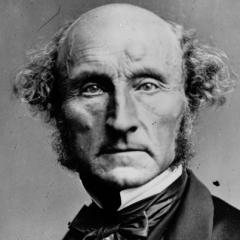
John Stuart MillRead
102 quotes
In all intellectual debates, both sides tend to be correct in what they affirm, and wrong in what they deny.
Landlords grow rich in their sleep without working, risking or economising
Genius can only breathe freely in an atmosphere of freedom.
The application of algebra to geometry ... has immortalized the name of Descartes, and constitutes the greatest single step ever made in the progress of the exact sciences.
The struggle between Liberty and Authority is the most conspicuous feature in the portions of history with which we are earliest familiar; particularly in that of Greece, Rome, and England
Men are men before they are lawyers, or physicians, or merchants, or manufacturers; and if you make them capable and sensible men, they will make themselves capable and sensible lawyers or physicians.
Men do not want solely the obedience of women, they want their sentiments.
The natural tendency of representative government, as of modern civilisation, is towards collective mediocrity: and this tendency is increased by all reductions and extensions of the franchise, their effect being to place the principal power in the hands of classes more and more below the highest level of instruction in the community.
...it is not only the general principles of justice that are infringed, or at least set aside, by the exclusion of women, merely as women, from any share in the representation; that exclusion is also repugnant to the particular principles of the British Constitution. It violates one of the oldest of our constitutional maxims...that taxation and representation should be co-extensive. Do not women pay taxes?
Not the violent conflict between parts of the truth, but the quiet suppression of half of it, is the formidable evil; there is always hope when people are forced to listen to both sides; it is when they attend to only one that errors harden into prejudices, and truth itself ceases to have the effect of truth, by being exaggerated into falsehood.
In proportion to the development of his individuality, each person becomes more valuable to himself, and is therefore capable of being more valuable to others. . . .
I will call no being good who is not what I mean when I apply that epithet to my fellow creatures; and if such a creature can sentence me to hell for not so calling him, to hell I will go .
Everything must be free to be written and published without restraint.
All action is for the sake of some end; and rules of action, it seems natural to suppose, must take their whole character and color from the end to which they are subservient.
Popular opinions, on subjects not palpable to sense, are often true, but seldom or never the whole truth.
That so few now dare to be eccentric, marks the chief danger of the time.
The fatal tendency of mankind to leave off thinking about a thing when it is no longer doubtful is the cause of half their errors.
On religion in particular, the time appears to me to have come, when it is a duty of all who, being qualified in point of knowledge, have, on mature consideration, satisfied themselves that the current opinions are not only false, but hurtful, to make their dissent known.
With equality of experience and of general faculties, a woman usually sees much more than a man of what is immediately before her.
The individual is not accountable to society for his actions in so far as these concern the interests of no person but himself.
A man of clear ideas errs grievously if he imagines that whatever is seen confusedly does not exist; it belongs to him, when he meets with such a thing, to dispel the midst, and fix the outlines of the vague form which is looming through it.
Subscribe for the occasional hand-picked quote. No noise.