Reason is the main resource of man in his struggle for survival.
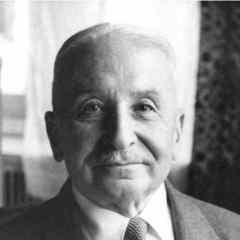
Ludwig Von MisesRead
130 quotes
Reason is the main resource of man in his struggle for survival.
The first thing a genius needs is to breath free air.
Value is not intrinsic, it is not in things. It is within us; it is the way in which man reacts to the conditions of his environment. Neither is value in words and doctrines, it is reflected in human conduct. It is not what a man or groups of men say about value that counts, but how they act.
Under capitalism everybody is the architect of his own fortune.
He who is unfit to serve his fellow citizens wants to rule them.
It is not the fault of the entrepreneurs that the consumers,the people, the common man,prefer liquor to Bibles and detective stories to serious books, and that governments prefer guns to butter. The entrepreneur does not make greater profits in selling bad things than in selling good things. His profits are the greater the better he succeeds in providing the consumers with those things they ask for most intensely.
The struggle for freedom is not the struggle of the many against the few, but of minorities, sometimes of a minority of but one man gainst the majority.
The root of the evil is not the construction of new, more dreadful weapons. It is the spirit of conquest.
The state can be and has often been in the course of history the main source of mischief and disaster.
Whoever wants peace among nations must seek to limit the state and its influence most strictly.
There cannot be stable money within an environment dominated by ideologies hostile to the preservation of economic freedom.
The word "Capitalism" expresses, for our age, the sum of all evil. Even the opponents of Socialism are dominated by socialist ideas.
The capitalistic social order, therefore, is an economic democracy in the strictest sense of the word. In the last analysis, all decisions are dependent on the will of the people as consumers. Thus, whenever there is a conflict between the consumers' views and those of the business managers, market pressures assure that the views of the consumers win out eventually.
It is inherent in the nature of the capitalistic economy that, in the final analysis, the employment of the factors of production is aimed only toward serving the wishes of consumers.
There is no western, capitalistic country in which the conditions of the masses have not improved in an unprecedented way.
The characteristic feature of capitalism that distinguishes it from pre-capitalist methods of production was its new principle of marketing. Capitalism is not simply mass production, but mass production to satisfy the needs of the masses.
Capitalism is essentially a system of mass production for the satisfaction of the needs of the masses. It pours a horn of plenty upon the common man. It has raised the average standard of living to a height never dreamed of in earlier ages. It has made accessible to millions of people enjoyments which a few generations ago were only within the reach of a small élite.
The unpopularity of economics is the result of its analysis of the effects of privileges. It is impossible to invalidate the economists demonstration that all privileges hurt the interests of the rest of the nation or at least a great part of it.
Economics is not about things and tangible material objects; it is about men, their meanings and actions.
Peace and not war is the father of all things.
The Reichswirtschaftsministerium ('Reich Ministry of Economic Affairs') tells the shop managers what and how to produce, at what prices and from whom to buy, at what prices and to whom to sell. It assigns every worker to his job and fixes his wages. It decrees to whom and on what terms the capitalists must entrust their funds. Market exchange is merely a sham.
Subscribe for the occasional hand-picked quote. No noise.