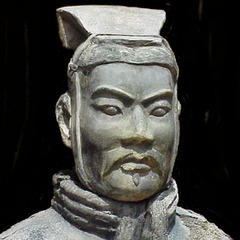
Invincibility depends on one's self; the enemy's vulnerability on him.
Sun TzuRead
175 quotes
Invincibility depends on one's self; the enemy's vulnerability on him.
If asked how to cope with a great host of the enemy in orderly array and on the point of marching to the attack, I should say: "Begin by seizing something which your opponent holds dear; then he will be amenable to your will." Rapidity is the essence of war: take advantage of the enemy's unreadiness, make your way by unexpected routes, and attack unguarded spots.
Swift as the wind. Quiet as the forest. Conquer like the fire. Steady as the mountain
Agitate him and ascertain the pattern of his movement.
When one treats people with benevolence, justice and righteousness, and reposes confidence in them, the army will be united in mind and all will be happy to serve their leaders.
When the enemy's envoy's speak in humble terms, but continues his preparations, he will advance. When their language is deceptive but the enemy pretentiously advances, he will retreat. When the envoys speak in apologetic terms, he wishes a respite. When without a previous understanding the enemy asks for a truce, he is plotting. When the enemy sees an advantage but does not advance to seize it, he is fatigued.
Opportunities multiply as they are seized.
There is nothing more difficult than tactical maneuvering. The difficult consists in turning the devious into the direct, and misfortune into gain. Thus, to take a long and circuitous route after enticing the enemy out of the way, and though starting after him to contrive to reach the goal before him, shows knowledge of the artifice of deviation.
It is said that if you know your enemies and know yourself, you will not be imperiled in a hundred battles; if you do not know your enemies but do know yourself, you will win one and lose one; if you do not know your enemies nor yourself, you will be imperiled in every single battle.
Know the enemy and know yourself; in a hundred battles you will never peril.
Know thy self, know thy enemy. A thousand battles, a thousand victories.
Therefore a victorious army first wins and then seeks battle; a defeated army first battles and then seeks victory.
When the higher officers are angry and insubordinate, and on meeting the enemy give battle on their own account from a feeling of resentment, before the commander-in-chief can tell whether or not he is in a position to fight, the result is ruin.
No ruler should put troops into the field merely to gratify his own spleen; no general should fight a battle simply out of pique.
Unhappy is the fate of one who tries to win his battles and succeed in his attacks without cultivating the spirit of enterprise, for the result is waste of time and general stagnation.
Ultimate excellence lies not in winning every battle, but in defeating the enemy without ever fighting.
And therefore those skilled in war bring the enemy to the field of battle and are not brought there by him.
Whoever is first in the field and awaits the coming of the enemy, will be fresh for the fight; whoever is second in the field and has to hasten to battle will arrive exhausted.
Engage people with what they expect; it is what they are able to discern and confirms their projections. It settles them into predictable patterns of response, occupying their minds while you wait for the extraordinary moment - that which they cannot anticipate.
Humble words and increased preparations are signs that the enemy is about to advance. Violent language and driving forward as if to the attack are signs that he will retreat.
The King is only fond of words, and cannot translate them into deeds.
Subscribe for the occasional hand-picked quote. No noise.