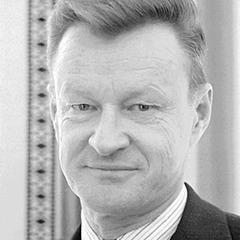
Hard power makes sense under some circumstances. But there's not a universal solution to global problems.
Zbigniew BrzezinskiRead
58 quotes
Hard power makes sense under some circumstances. But there's not a universal solution to global problems.
The culture of self-gratification and deregulation that began during the Clinton years and continued under President George W. Bush led to the bursting of one stock market bubble at the turn of the century and a full-scale financial crash less than a decade later.
A president who aspires to be recognized as a global leader should not personally stake out a foreign-policy goal, commit himself eloquently to its attainment, and then yield the ground when confronted by firm opposition.
Human affairs require some combination of moral commitment with disciplined political action. And that is what keeps me intrigued and challenged and wanting to influence events.
Neither the United States nor Israel has the capacity to impose a unilateral solution in the Middle East.
If we slide into a pattern of just thinking about today, we'll end up reacting to yesterday instead of shaping something more constructive in the world.
If the United States and China can accommodate each other on a broad range of issues, the prospects for stability in Asia will be greatly increased.
We can't have an intelligent foreign policy unless we have an intelligent public, because we're a democracy.
Missing from much of the public debate is discussion of the simple fact that lurking behind every terroristic act is a specific political antecedent. That does not justify either the perpetrator or his political cause. Nonetheless, the fact is that almost all terrorist activity originates from some political conflict and is sustained by it as well.
It is important to ask ourselves, as citizens, whether a world power can provide global leadership on the basis of fear and anxiety.
Indeed, for almost 10 years, Moscow had to carry on a war unsupportable by the government, a conflict that brought about the demoralization and finally the breakup of the Soviet empire.
War triggers unforeseeable military dynamics and sets off massive political shocks, creating new problems as well as new opportunities.
I have been struck by the pervasive frequency of pompously patriotic ads for the defense industry, usually accompanied by deferential salutations to our men and women who are heroically sacrificing their lives in our defense. Do we really need all of that for our security?
Sometimes in international politics, the better part of wisdom is to defer dangers rather than try to eliminate them altogether instantly.
If we can deter the Soviet Union, if we can deter North Korea, why on earth can't we deter Iran?
I don't approve of the notion that we should be announcing who should step down from the position of a head of a state unless we are seriously prepared to remove that person. But if we are not, if we are being prudent and careful, then let's also be careful with how we talk.
Subscribe for the occasional hand-picked quote. No noise.