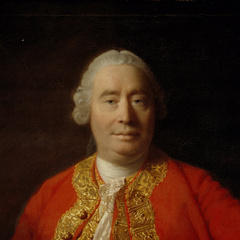
Superstition is an enemy to civil liberty.
David HumeRead
80 quotes
Superstition is an enemy to civil liberty.
[priests are] the pretenders to power and dominion, and to a superior sanctity of character, distinct from virtue and good morals.
While Newton seemed to draw off the veil from some of the mysteries of nature, he showed at the same time the imperfections of the mechanical philosophy; and thereby restored her ultimate secrets to that obscurity, in which they ever did and ever will remain.
It seems to me, that the only Objects of the abstract Sciences or of Demonstration is Quantity and Number, and that all Attempts to extend this more perfect Species of Knowledge beyond these Bounds are mere Sophistry and Illusion.
All knowledge resolves itself into probability. ... In every judgment, which we can form concerning probability, as well as concerning knowledge, we ought always to correct the first judgment deriv'd from the nature of the object, by another judgment, deriv'd from the nature of the understanding.
All knowledge degenerates into probability.
Tho' there be no such Thing as Chance in the World; our Ignorance of the real Ccause of any Event has the same Influence on the Understanding, and begets a like Species of Belief or Opinion.
All this creative power of the mind amounts to no more than the faculty of compounding, transposing, augmenting, or diminishing the materials afforded us the by senses and experience.
God is an ever-present spirit guiding all that happens to a wise and holy end.
I do not have enough faith to believe there is no god.
The heights of popularity and patriotism are still the beaten road to power and tyranny; flattery to treachery; standing armies to arbitrary government; and the glory of God to the temporal interest of the clergy.
Art may make a suite of clothes, but nature must produce a man.
The sweetest path of life leads through the avenues of learning, and whoever can open up the way for another, ought, so far, to be esteemed a benefactor to mankind.
Mankind are so much the same, in all times and places, that history informs us of nothing new or strange in this particular. Its chief use is only to discover the constant and universal principles of human nature.
History is the discovering of the principles of human nature.
The identity that we ascribe to things is only a fictitious one, established by the mind, not a peculiar nature belonging to what we’re talking about.
How can we satisfy ourselves without going on in infinitum? And, after all, what satisfaction is there in that infinite progression? Let us remember the story of the Indian philosopher and his elephant. It was never more applicable than to the present subject. If the material world rests upon a similar ideal world, this ideal world must rest upon some other; and so on, without end. It were better, therefore, never to look beyond the present material world.
The feelings of our heart, the agitation of our passions, the vehemence of our affections, dissipate all its conclusions, and reduce the profound philosopher to a mere plebeian
It is an absurdity to believe that the Deity has human passions, and one of the lowest of human passions, a restless appetite for applause
All sentiment is right; because sentiment has a reference to nothing beyond itself, and is always real, wherever a man is conscious of it. But all determinations of the understanding are not right; because they have a reference to something beyond themselves, to wit, real matter of fact; and are not always conformable to that standard.
Liberty of any kind is never lost all at once.
Subscribe for the occasional hand-picked quote. No noise.