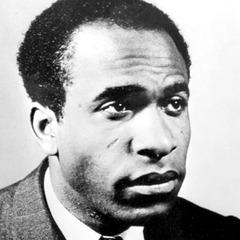
A government or a party gets the people it deserves and sooner or later a people gets the government it deserves.
Frantz FanonRead
28 quotes
A government or a party gets the people it deserves and sooner or later a people gets the government it deserves.
When we revolt it’s not for a particular culture. We revolt simply because, for many reasons, we can no longer breathe.
Certain things need to be said if one is to avoid falsifying the problem.
I want the world to recognize with me the open door of every consciousness
The gaze that the colonized subject casts at the colonist's sector is a look of lust, a look of envy. Dreams of possession. Every type of possession; of sitting at the colonist's table and sleeping in his bed, preferably with his wife. The colonized man is an envious man.
Hate demands existence, and he who hates has to show his hate in appropriate actions and behaviors; in a sense, he has to become hate. That is why the Americans have substituted discrimination for lynching.
Violence is man re-creating himself.
If the building of a bridge does not enrich the awareness of those who work on it, then the bridge ought not to be built.
The settler makes history and is conscious of making it. And because he constantly refers to the history of his mother country, he clearly indicates that he himself is the extension of that mother country. Thus the history which he writes is not the history of the country which he plunders but the history of his own nation in regard to all that she skims off, all that she violates and starves.
Anti-Semitism hits me on the head: I am enraged, I am bled white by an appalling battle, I am deprived of the possibility of being man. I cannot disassociate myself from the future that is proposed for my brother.
And it is clear that in the colonial countries the peasants alone are revolutionary, for they have nothing to lose and everything to gain. The starving peasant, outside the class system is the first among the exploited to discover that only violence pays. For him there is no compromise, no possible coming to terms; colonization and decolonization a simply a question of relative strength.
What I call middle-class society is any society that becomes rigidified in predetermined forms, forbidding all evolution, all gains, all progress, all discovery. I call middle-class a closed society in which life has no taste, in which the air is tainted, in which ideas and men are corrupt. And I think that a man who takes a stand against this death is in a sense a revolutionary.
Today I believe in the possibility of love; that is why I endeavor to trace its imperfections, its perversions.
Each generation must discover its mission, fulfill it or betray it, in relative opacity.
I ascribe a basic importance to the phenomenon of language. To speak means to be in a position to use a certain syntax, to grasp the morphology of this or that language, but it means above all to assume a culture, to support the weight of a civilization.
He who is reluctant to recognize me opposes me.
In the colonial context the settler only ends his work of breaking in the native when the latter admits loudly and intelligibly the supremacy of the white man's values.
The native must realize that colonialism never gives anything away for nothing.
Colinialism hardly ever exploits the whole of a country. It contents itself with bringing to light the natrual resources, which it extracts, and exports to meet the needs of the mother country's industries, thereby allowing certain sectors of the colony to become relatively rich. But the rest of the colony follows its path of under-development and poverty, or at all events sinks into it more deeply.
When people like me, they like me "in spite of my color." When they dislike me; they point out that it isn't because of my color. Either way, I am locked in to the infernal circle.
Introducing someone as a "Negro poet with a University degree" or again, quite simply, the expression, "a great black poet." These ready-made phrases, which seem in a common-sense way to fill a need-or have a hidden subtlety, a permanent rub.
Subscribe for the occasional hand-picked quote. No noise.