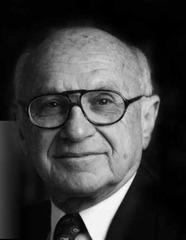
See, if you look at the drug war from a purely economic point of view, the role of the government is to protect the drug cartel. That's literally true.
Milton FriedmanRead
90 quotes
See, if you look at the drug war from a purely economic point of view, the role of the government is to protect the drug cartel. That's literally true.
A society based on the freedom to choose is better than a society based on the principles of socialism, communism and coercion.
Fundamentally, there are only two ways of coordinating the economic activities of millions. One is central direction involving the use of coercion - the technique of the army and of the modern totalitarian state. The other is voluntary cooperation of individuals - the technique of the marketplace.
I cannot disagree with you that having something like 500 economists is extremely unhealthy. As you say, it is not conducive to independent, objective research. You and I know there has been censorship of the material published. Equally important, the location of the economists in the Federal Reserve has had a significant influence on the kind of research they do, biasing that research toward noncontroversial technical papers on method as opposed to substantive papers on policy and results
Business corporations in general are not defenders of free enterprise. On the contrary, they are one of the_x000D_ chief sources of danger....Every businessman is in favor of freedom for everybody else, but when it comes to himself that's a different question. We have to have that tariff to protect us against competition from abroad. We have to have that special provision in the tax code. We have to have that subsidy.
There are severe limits to the good that the government can do for the economy, but there are almost no limits to the harm it can do.
The real tragedy of minimum wage laws is that they are supported by well-meaning groups who want to reduce poverty. But the people who are hurt most by higher minimums are the most poverty stricken.
With some notable exceptions, businessmen favor free enterprise in general but are opposed to it when it comes to themselves.
I think a major reason why intellectuals tend to move towards collectivism is that the collectivist answer is a simple one. If there's something wrong, pass a law and do something about it.
Cutting government spending and government intrusion in the economy will almost surely involve immediate gain for the many, short-term pain for the few, and long-term gain for all.
If, for example, existing government intervention is minor, we shall attach a smaller weight to the negative effect of additional government intervention. This is an important reason why many earlier liberals, like Henry Simons, writing at a time when government was small by today's standards, were willing to have government undertake activities that today's liberals would not accept now that government has become so overgrown.
Since the 1930s the technique of buying votes with the voters' own money has been expanded to an extent undreamed of by earlier politicians.
Higher taxes never reduce the deficit. Governments spend whatever they take in and then whatever they can get away with.
The Fed was largely responsible for converting what might have been a garden-variety recession, although perhaps a fairly severe one, into a major catastrophe. Instead of using its powers to offset the depression, it presided over a decline in the quantity of money by one-third from 1929 to 1933 ... Far from the depression being a failure of the free-enterprise system, it was a tragic failure of government.
Humility is the distinguishing virtue of the believer in freedom; arrogance, of the paternalist.
If the government is to try and ban private consumption of alcohol and tobacco, it must surely ban such activities as hang-gliding, skiing, rock-climbing and so on. Where should it stop? Rugby? American Football? Ice Hockey? _x000D_ Insofar as the government has information not generally available about the merits or demerits of the items we ingest or the activities we engage in, let it give us the information. But let it leave us free to choose what chances we want to take with our own lives.
The only way that has ever been discovered to have a lot of people cooperate together voluntarily is through the free market. And that's why it's so essential to preserving individual freedom.
The most important single central fact about a free market is that no exchange takes place unless both parties benefit.
When government - in pursuit of good intentions - tries to rearrange the economy, legislate morality, or help special interests, the cost come in inefficiency, lack of motivation, and loss of freedom. Government should be a referee, not an active player.
The greatest advances of civilization, whether in architecture or painting, in science and literature, in industry or agriculture, have never come from centralized government.
The free market is not only a more efficient decision maker than even the wisest central planning body, but even more important, the free market keeps economic power widely dispersed.
Subscribe for the occasional hand-picked quote. No noise.