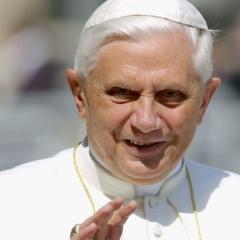
We let ourselves be molded and transformed by Christ and continually pass from the side of one who destroys to that of the one who saves.
Pope Benedict XviRead
232 quotes
We let ourselves be molded and transformed by Christ and continually pass from the side of one who destroys to that of the one who saves.
While we rejoice in the new possibilities open to humanity, we also see the dangers arising from these possibilities, and we must ask ourselves how we can overcome them.
It is important to be in the 'we' of the Church, in the 'we' of the life of the Liturgy.
We need Grace and forgiveness.
Loving the church also means having the courage to make difficult, trying choices, having ever before oneself the good of the church and not one's own.
The reality of the Eucharistic sacrifice has always been at the heart of Catholic faith; called into question in the 16th century, it was solemnly reaffirmed at the Council of Trent against the backdrop of our justification in Christ.
The hatred and contempt for men, women and children that was manifested in the Shoah was a crime against God and against humanity.
Germany has an established and well-furnished Catholicism, often with employed Catholics who handle the church like a labor union. For them, the church is simply the employer.
Every State has the primary duty to protect its own population from grave and sustained violations of human rights, as well as from the consequences of humanitarian crises, whether natural or man-made.
The Catholic community must offer support to those women who may find it difficult to accept a child, above all when they are isolated from their family and friends. Likewise, the community should be open to welcome back all who repent of having participated in the grave sin of abortion, and should guide them with pastoral charity to accept the grace of forgiveness, the need for penance, and the joy of entering once more into the new life of Christ.
Holiness does not consist in not making mistakes or never sinning. Holiness grows with capacity for conversion, repentance, willingness to begin again, and above all with the capacity for reconciliation and forgiveness.
I would designate as science fiction in the best sense: they are visions and anticipations by which we seek to attain a true knowledge, but, in fact, they are only imaginations whereby we seek to draw near to the reality.
I use both the 'I' and the 'we.' For on many, many matters, I am not simply expressing ideas that have happened to occur to Joseph Ratzinger, but I am speaking out of the common life of the Church's communion.
If you abide in the love of Christ, rooted in the faith, you will encounter, even amid setbacks and suffering, the source of true happiness and joy. Faith does not run counter to your highest ideals; on the contrary, it elevates and perfects those ideals. Dear young people, do not be satisfied with anything less than Truth and Love, do not be content with anything less than Christ.
I would say that normally it is the creative minorities that determine the future, and in this sense, the Catholic Church must understand itself as a creative minority that has a heritage of values that are not things of the past, but a very living and relevant reality.
Before His gaze all falsehood melts away. This encounter with Him, as it burns us, transforms and frees us, allowing us to become truly ourselves... His gaze, the touch of His heart heals us through an undeniably painful transformation "as through fire". But it is a blessed pain, in which the holy power of His love sears through us like a flame, enabling us to become totally ourselves and thus totally of God.
The principle of tolerance and respect for freedom promoted by the reforms of the Second Vatican Council are today being manipulated and erroneously taken too far.
Today Christmas has become a commercial celebration, whose bright lights hide the mystery of God’s humility, which in turn calls us to humility and simplicity. Let us ask the Lord to help us see through the superficial glitter of this season, and to discover behind it the child in the stable in Bethlehem, so as to find true joy and true light.
Wherever applause breaks out in the liturgy because of some human achievement, it is a sure sign that the essence of liturgy has totally disappeared and been replaced by a kind of religious entertainment. Such attraction fades quickly - it cannot compete in the market of leisure pursuits, incorporating as it increasingly does various forms of religious titillation.
Jesus Christ does not teach us a spirituality “of closed eyes”, but one of “alertness”, one which entails an absolute duty to take notice of the needs of others and of situations involving those whom the Gospel tells us are our neighbours. The gaze of Jesus, what “his eyes” teach us, leads to human closeness, solidarity, giving time, sharing our gifts and even our material goods.
The ecological crisis shows the urgency of a solidarity which embraces time and space... A greater sense of intergenerational solidarity is urgently needed. Future generations cannot be saddled with the cost of our use of common environmental resources.
Subscribe for the occasional hand-picked quote. No noise.