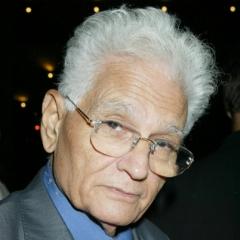
The blindness that opens the eye is not the one that darkens vision. Tears and not sight are the essence of the eye.
Jacques DerridaRead
23 quotes
The blindness that opens the eye is not the one that darkens vision. Tears and not sight are the essence of the eye.
Everything is arranged so that it be this way, this is what is called culture.
No one gets angry at a mathematician or a physicist whom he or she doesn't understand, or at someone who speaks a foreign language, but rather at someone who tampers with your own language.
Psychoanalysis has taught that the dead – a dead parent, for example – can be more alive for us, more powerful, more scary, than the living. It is the question of ghosts.
The trace I leave to me means at once my death, to come or already come, and the hope that it will survive me. It is not an ambition of immortality; it is fundamental. I leave here a bit of paper, I leave, I die; it is impossible to exit this structure; it is the unchanging form of my life. Every time I let something go, I live my death in writing.
Every discourse, even a poetic or oracular sentence, carries with it a system of rules for producing analogous things and thus an outline of methodology.
A text is not a text unless it hides from the first comer, from the first glance, the law of its composition and the rules of its game. A text remains, moreover, forever imperceptible. Its laws and rules are not, however, harbored in the inaccessibility of a secret; it is simply that they can never be booked, in the present, into anything that could rigorously be called a perception.
Such a caring for death, an awakening that keeps vigil over death, a conscience that looks death in the face, is another name for freedom.
Certain readers resented me when they could no longer recognize their territory, their institution.
There is nothing outside the text
My most resolute opponents believe that I am too visible, that I am a little too alive, that my name echoes too much in the texts which they nevertheless claim to be inaccessible.
In Algeria, I had begun to get into literature and philosophy. I dreamed of writing-and already models were instructing the dream, a certain language governed it.
I have always had trouble recognizing myself in the features of the intellectual playing his political role according to the screenplay that you are familiar with and whose heritage deserves to be questioned.
That is what deconstruction is made of: not the mixture but the tension between memory, fidelity, the preservation of something that has been given to us, and, at the same time, heterogeneity, something absolutely new, and a break.
Whatever precautions you take so the photograph will look like this or that, there comes a moment when the photograph surprises you. It is the other's gaze that wins out and decides.
Survival in the conventional sense of the term means to continue to live, but also to live after death.
Surviving - that is the other name of a mourning whose possibility is never to be awaited.
We are all mediators, translators.
The only attitude (the only politics--judicial, medical, pedagogical and so forth) I would absolutely condemn is one which, directly or indirectly, cuts off the possibility of an essentially interminable questioning, that is, an effective and thus transforming questioning.
In philosophy, you have to reckon with the implicit level of an accumulated reserve, and thus with a very great number of relays, with the shared responsibility of these relays.
Why is it apparently the philosopher who is expected to be "easier" and not some scientist or other who is even more inaccessible to the same readers?
Subscribe for the occasional hand-picked quote. No noise.