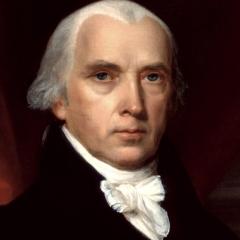
I go on the principle that a public debt is a public curse and in a republican government more than in any other.
James MadisonRead
169 quotes
I go on the principle that a public debt is a public curse and in a republican government more than in any other.
No man is allowed to be a judge in his own cause; because his interest would certainly bias his judgment, and, not improbably, corrupt his integrity. With equal, nay with greater reason, a body of men are unfit to be both judges and parties at the same time.
I believe there are more instances of the abridgment of the freedom of the people by gradual and silent encroachments of those in power, than by violent and sudden usurpations; but, on a candid examination of history, we shall find that turbulence, violence, and abuse of power, by the majority trampling on the rights of the minority, have produced factions and commotions, which, in republics, have, more frequently than any other cause, produced despotism.
The advice nearest to my heart and deepest in my convictions is that the Union of the States be cherished and perpetuated.
Knowledge will forever govern ignorance; and a people who mean to be their own governors must arm themselves with the power which knowledge gives.
The magnitude of this evil among us is so deeply felt, and so universally acknowledged, that no merit could be greater than that of devising a satisfactory remedy for it.
It was by the sober sense of our citizens that we were safely and steadily conducted from monarchy to republicanism, and it is by the same agency alone we can be kept from falling back.
Democracies have been found incompatible with personal security or the rights of property; and in general been as short in their lives as they have been violent in their death.
The essence of Government is power; and power, lodged as it must be in human hands, will ever be liable to abuse.
In this relation, then, the proposed government cannot be deemed a national one; since its jurisdiction extends to certain enumerated objects only, and leaves to the several states, a residuary and inviolable sovereignty over all other objects.
We have seen the mere distinction of color made in the most enlightened period of time, a ground of the most oppressive dominion ever exercised by man over man.
That the foundation of our national policy should be laid in private morality. If individuals be not influenced by moral principles, it is in vain to look for public virtue; it is, therefore, the duty of legislators to enforce, both by precept and example, the utility, as well as the necessity, of a strict adherence to the rules of distributive justice.
The governments of Europe are afraid to trust the people with arms. If they did, the people would certainly shake off the yoke of tyranny, as America did.
The accumulation of all powers, legislative, executive, and judiciary, in the same hands, whether of one, a few, or many, and whether hereditary, selfappointed, or elective, may justly be pronounced the very definition of tyranny.
The Convention thought it wrong to admit in the Constitution the idea that there could be property in men.
Every nation whose affairs betray a want of wisdom and stability may calculate on every loss which can be sustained from the more systematic policy of its wiser neighbors.
Frequent elections are unquestionably the only policy by which this dependence and sympathy can be effectually secured. But what particular degree of frequency may be absolutely necessary for the purpose, does not appear to be susceptible of any precise calculation; and must depend on a variety of circumstances with which it may be connected. Let us consult experience, the guide that ought always to be followed, whenever it can be found.
The powers delegated by the proposed Constitution to the federal government are few and defined. Those which are to remain in the State governments are numerous and indefinite.
A government resting on the minority is an aristocracy, not a Republic, and could not be safe with a numerical and physical force against it, without a standing army, an enslaved press and a disarmed populace.
The strongest passions and most dangerous weaknesses of the human breast; ambition, avarice, vanity, the honorable or venal love of fame, are all in conspiracy against the desire and duty of peace.
In a society under the forms of which the stronger faction can readily unite and oppress the weaker, anarchy may as truly be said to reign as in a state of nature.
Subscribe for the occasional hand-picked quote. No noise.