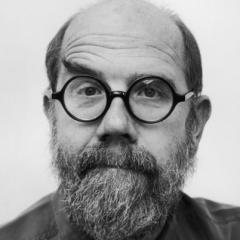
I never said the camera was truth. It is, however, a more accurate and more objective way of seeing.
Chuck CloseRead
31 quotes
I never said the camera was truth. It is, however, a more accurate and more objective way of seeing.
A photograph doesn't gain weight or lose weight, or change from being happy to being sad. It's frozen. You can use it, then recycle it.
The advice I like to give young artists, or really anybody who’ll listen to me, is not to wait around for inspiration. Inspiration is for amateurs; the rest of us just show up and get to work.
Neurologically, I'm a quadriplegic, so virtually everything about my work has been driven by my learning disabilities, which are quite severe, and my lack of facial recognition, which I'm sure is what drove me to paint portraits in the first place.
Part of the joy of looking at art is getting in sync in some ways with the decision-making process that the artist used and the record that's embedded in the work.
Losing my father at a tender age was extremely important in being able to accept what happened to me later when I became a quadriplegic.
All the best ideas come out of the process; they come out of the work itself.
Every idea occurs while you are working. If you are sitting around waiting for inspiration, you could sit there forever.
I learned you could suffer a terrible tragedy and still be happy again.
I am going for a level of perfection that is only mine... Most of the pleasure is in getting the last little piece perfect.
Inspiration is highly overrated. If you sit around and wait for the clouds to part, it's not liable to ever happen. More often than not, work is salvation.
Painting is the frozen evidence of a performance.
I wanted to translate from one flat surface to another. In fact, my learning disabilities controlled a lot of things. I don't recognize faces, so I'm sure it's what drove me to portraits in the first place.
You know, the way art history is taught, often there's nothing that tells you why the painting is great. The description of a lousy painting and the description of a great painting will very much sound the same.
I'm not by nature a terribly intuitive person; I need to build a situation in which I will behave more intuitively, and that has really changed the life of my work - I found a way to trick myself into being intuitive.
I don't want the viewer to be able to peel away the layers of my painting like the layers of an onion and find that all the blues are on the same level.
You don't have to have a great art idea - just get to work and something will happen. So that's pretty much my modus operandi and pretty much my principal position, such as it is.
Once I started working with the Polaroid, I would take a shot and if that shot was good, then I'd move the model and change the lighting or whatever... slowly sneaking up on what I wanted rather than having to predetermine what it was.
Paintings can make you cry and it's just **colored dirt**.
I knew from the age of five what I wanted to do. The one thing I could do was draw. I couldn't draw that much better than some of the other kids, but I cared more and I wanted it badly.
I can't always reach the image in my mind... almost never, in fact... so that the abstract image I create is not quite there, but it gets to the point where I can leave it.
Subscribe for the occasional hand-picked quote. No noise.