I don't agree with the sentiment 'write what you know.'... I think one should write what one doesn't know. The world is bigger and wider and more complex than our small subjective selves. One should prod, goad the imagination.
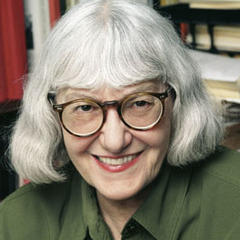
Cynthia OzickRead
23 quotes
I don't agree with the sentiment 'write what you know.'... I think one should write what one doesn't know. The world is bigger and wider and more complex than our small subjective selves. One should prod, goad the imagination.
I'm not afraid of facts, I welcome facts but a congeries of facts is not equivalent to an idea. This is the essential fallacy of the so-called "scientific" mind. People who mistake facts for ideas are incomplete thinkers; they are gossips.
Above all, a book is a riverbank for the river of language. Language without the riverbank is only television talk - a free fall, a loose splash, a spill.
An article can be timely, topical, engaged in the issues and personalities of the moment; it is likely to be stale within the month. In five years, it may have acquired the quaint aura of a rotary phone. An article is usually Siamese-twinned to its date of birth.
A writer is dreamed and transfigured into being by spells, wishes, goldfish, silhouettes of trees, boxes of fairy tales dropped in the mud, uncles' and cousins' books, tablets and capsules and powders...and then one day you find yourself leaning here, writing on that round glass table salvaged from the Park View Pharmacy--writing this, an impossibility, a summary of who you came to be where you are now, and where, God knows, is that?
No one can teach writing, but classes may stimulate the urge to write. If you are born a writer, you will inevitably and helplessly write. A born writer has self-knowledge. Read, read, read. And if you are a fiction writer, don't confine yourself to reading fiction. Every writer is first a wide reader.
I don't like to read contemporary fiction while writing - I need a sense of isolation, a kind of silence, and I don't want a jumble of other people's voices or visions getting in my way. Nineteenth-century voices don't create static in that silence.
I wanted to use what I was, to be what I was born to be - not to have a 'career', but to be that straightforward obvious unmistakable animal, a writer.
Is there a word more passionate than passion? Obsession, total immersion, the feeling that everything else doesn't matter.
It is the function of a liberal university not to give right answers, but to ask right questions.
To say that such-and-such a circumstance is 'Kafkaesque' is to admit to the denigration of an imagination that has burned a hole in what we take to be modernism - even in what we take to be the ordinary fabric and intent of language. Nothing is like 'The Hunger Artist.' Nothing is like 'The Metamorphosis.'
We often take for granted the very things that most deserve our gratitude.
People often ask how I can reject the phrase 'woman writer' and not reject the phrase 'Jewish writer' - a preposterous question. 'Jewish' is a category of civilization, culture, and intellect, and 'woman' is a category of anatomy and physiology.
I have lost stories and many starts of novels before. Not always as punishment for 'telling,' but more often as a result of something having gone cold and dead because of a hiatus. Telling, you see, is the same as a hiatus. It means you're not doing it.
Whoever utters 'Kafkaesque' has neither fathomed nor intuited nor felt the impress of Kafka's devisings. If there is one imperative that ought to accompany any biographical or critical approach, it is that Kafka is not to be mistaken for the Kafkaesque.
I'm afraid that the act of writing is so scary and anxiety-filled that I never laugh at all. In fact, when people tell me that such and such a scene or story is comical, I tend to gape. I did not intend comedy - ever, as far as I know. It's probably all a mistake. I am essentially a lugubrious writer. Ha ha!
If an essay has a 'motive,' it is linked more to happenstance and opportunity than to the driven will. A genuine essay is not a doctrinaire tract or a propaganda effort or a broadside.
Novelists go about the strenuous business of marrying and burying their people, or else they send them to sea, or to Africa, or at the least, out of town. Essayists in their stillness ponder love and death.
With certain rapturous exceptions, literature is the moral life.
Among contemporaries, I hugely admire Alice Munro, our Chekhov, Saul Bellow, Philip Roth, and John Updike, American masters all. I also believe that the voice of Gordon Lish is astoundingly original and sorrowful.
In an essay, you have the outcome in your pocket before you set out on your journey, and very rarely do you make an intellectual or psychological discovery. But when you write fiction, you don't know where you are going - sometimes down to the last paragraph - and that is the pleasure of it.
Subscribe for the occasional hand-picked quote. No noise.