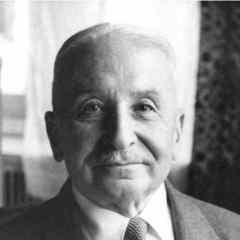
The market economy-capitalism-is a social system of consumers' supremacy.
Ludwig Von MisesRead
130 quotes
The market economy-capitalism-is a social system of consumers' supremacy.
Without calculation, economic activity is impossible. Since under Socialism economic calculation is impossible, under Socialism there can be no economic activity in our sense of the word All economic change, therefore, would involve operations the value of which could neither be predicted beforehand nor ascertained after they had taken place. Everything would be a leap in the dark. Socialism is the renunciation of rational economy.
All rational action is in the first place individual action. Only the individual thinks. Only the individual reasons. Only the individual acts.
If one rejects laissez faire on account of mans fallibility and moral weakness, one must for the same reason also reject every kind of government action.
The aim of all struggles for liberty is to keep in bounds the armed defenders of peace, the governors and their constables. The political concept of the individual's freedom means: freedom from arbitrary action on the part of the police power.
Action is an attempt to substitute a more satisfactory state of affairs for a less satisfactory one. We call such a willfully induced alteration an exchange.
What is a loophole? If the law does not punish a definite action or does not tax a definite thing, this is not a loophole. It is simply the law.
War is harmful, not only to the conquered but to the conqueror. Society has arisen out of the works of peace; the essence of society is peacemaking. Peace and not war is the father of all things. Only economic action has created the wealth around us; labor, not the profession of arms, brings happiness. Peace builds, war destroys.
There is no use in deceiving ourselves. American public opinion rejects the market economy, the capitalistic free enterprise system that provided the nation with the highest standard of living ever attained. Full government control of all activities of the individual is virtually the goal of both national parties.
The governments alone are responsible for the spread of the superstitious awe with which the common man looks upon every bit of paper upon which the treasury or agencies which it controls have printed the magical words legal tender.
Government means always coercion and compulsion and is by necessity the opposite of liberty.
The characteristic feature of militarism is not the fact that a nation has a powerful army or navy. It is the paramount role assigned to the army within the political structure. Even in peacetime the army is supreme; it is the predominant factor in political life. The subjects must obey the government as soldiers must obey their superiors. Within a militarist community there is no freedom; there are only obedience and discipline.
Man is born an asocial and antisocial being. The newborn child is a savage. Egoism is his nature. Only the experience of life and the teachings of his parents, his brothers, sisters, playmates, and later of other people FORCE HIM to acknowledge the advantages of social cooperation and accordingly to change his behavior.
The "progressives" who today masquerade as "liberals" may rant against "fascism"; yet it is their policy that paves the way for Hitlerism. Nothing could have been more helpful to the success of the National-Socialist (Nazi) movement than the methods used by the "progressives," denouncing Nazism as a party serving the interests of "capital." The German workers knew this tactic too well to be deceived by it again.
Used to the conditions of a capitalistic environment, the average American takes it for granted that every year business makes something new and better accessible to him. Looking backward upon the years of his own life, he realizes that many implements that were totally unknown in the days of his youth and many others which at that time could be enjoyed only by a small minority are now standard equipment of almost every household.
The recurrence of periods of depression and mass unemployment has discredited capitalism in the opinion of injudicious people. Yet these events are not the outcome of the operation of the free market. They are on the contrary the result of well-intentioned but ill-advised government interference with the market.
He who acts under an emotional impulse also acts. What distinguishes an emotional action from other actions is the valuation of input and output. Emotions disarrange valuations. Inflamed with passion, man sees the goal as more desirable and the price he has to pay for it as less burdensome than he would in cool deliberation.
There is an inherent tendency in all governmental power to recognize no restraints on its operation and to extend the sphere of its dominion as much as possible. To control everything, to leave no room for anything to happen of its own accord without the interference of the authorities--th is is the goal for which every ruler secretly strives.
No very deep knowledge of economics is usually needed for grasping the immediate effects of a measure; but the task of economics is to foretell the remoter effects, and so to allow us to avoid such acts as attempt to remedy a present ill by sowing the seeds of a much greater ill for the future.
Both force and money are impotent against ideas.
An intellectual inferiority of the masses would manifest itself most evidently in their aiming at the abolition of the system in which they themselves are supreme and are served by the elite of the most talented men.
Subscribe for the occasional hand-picked quote. No noise.