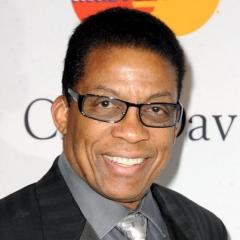
Music isn't about music, it's about life.
Herbie HancockRead
40 quotes
Music isn't about music, it's about life.
I don't mind being classified as a jazz artist, but I do mind being restricted to being a jazz artist. My foundation has been in jazz, though I didn't really start out that way. I started in classical music, but my formative years were in jazz, and it makes a great foundation.
In World War II, jazz absolutely was the music of freedom, and then in the Cold War, behind the Iron Curtain, same thing. It was all underground, but they needed the food of freedom that jazz offered.
I think people have learned that Herbie Hancock can be defined as someone that you won't be able to figure out what he's going to do next. The sky is the limit as far as I'm concerned.
One thing that sticks in my mind is that jazz means freedom and openness. It's a music that, although it developed out of the African American experience, speaks more about the human experience than the experience of a particular people.
I started off with classical music, and I got into jazz when I was about 14 years old. And I've been playing jazz ever since.
It's easy to get sidetracked with technology, and that is the danger, but ultimately you have to see what works with the music and what doesn't. In a lot of cases, less is more. In most cases, less is more.
Clare Fischer was a major influence on my harmonic concept. He and Bill Evans, and Ravel and Gil Evans, finally. You know, that's where it really came from. Almost all of the harmony that I play can be traced to one of those four people and whoever their influences were.
Jazz is about being in the moment.
Music happens to be an art form that transcends language.
We are eternally linked not just to each other but our environment.
A jazz musician is not a jazz musician when he or she is eating dinner or when he or she is with his parents or spouse or neighbors. He's above all a human being . . . the true artform is being a human being.
I've been practising Buddhism for forty years, and that's what has led me to this path of discovering my own humanity and recognizing the humanity in others.
I got a chance to work with Miles Davis, and that changed everything for me, 'cause Miles really encouraged all his musicians to reach beyond what they know, go into unknown territory and explore. It's made a difference to me and the decisions that I've made over the years about how to approach a project in this music.
When you talk about 'doing the work', that's the work I'm interested in. What can I contribute as a human being?
Most people define themselves by what they do - 'I'm a musician.' Then one day it occurred to me that I'm only a musician when I'm playing music - or writing music, or talking about music. I don't do that 24 hours a day. I'm also a father, a son, a husband, a citizen - I mean, when I go to vote, I'm not thinking of myself as 'a musician.'
One of the greatest experiences I ever had was listening to a conversation with Joni Mitchell and Wayne Shorter. Just to hear them talking, my mouth was open. They understand each other perfectly, and they make these leaps and jumps because they don't have to explain anything.
So much of what I create has been due to the influence of Miles Davis and Donald Byrd, and so many of those that have passed on. Their music, their legacy lives on with the rest of us because we are so highly influenced by their experience and what they have given us.
The cool thing is that jazz is really a wonderful example of the great characteristics of Buddhism and great characteristics of the human spirit. Because in jazz we share, we listen to each other, we respect each other, we are creating in the moment. At our best, we're non-judgmental.
Life is not about finding our limitations, it's about finding our infinity.
The most valuable things in life are priceless. They are courage, compassion, wisdom, respect for ourselves and others, and a host of characteristics that we call the beauty of the human spirit.
Subscribe for the occasional hand-picked quote. No noise.