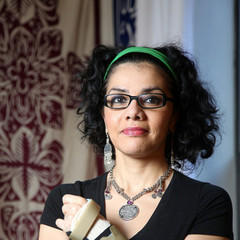
As a feminist of Egyptian and Muslim descent, my life's work has been informed by the belief that religion and culture must never be used to justify the subjugation of women.
Mona EltahawyRead
21 quotes
As a feminist of Egyptian and Muslim descent, my life's work has been informed by the belief that religion and culture must never be used to justify the subjugation of women.
I'm no fan of Sarkozy, but I support a ban on face veils because they erase women from society and are promoted by an ultra-conservative ideology that equates piety with the disappearance of women.
It is the harassers and assaulters who make us 'look bad,' not the women who have every right to expose crimes against them.
I can write about my culture and religion because I am a product of both. Even when I'm accused of giving ammunition to the Islamophobic right, in the struggle between 'community' and 'women,' I always choose the women.
I believe at the heart of any revolution for social justice and human dignity are consent and agency, the unequivocal belief that I own my body - not the state, not the church/mosque/temple, not the street and not the family.
I will never ally with Islamophobes and racists. But in the choice between 'community' and Muslim women, I will always choose my sisters.
I detest the niqab and the burka for their erasure of women and for dangerously equating piety with that disappearance - the less of you I can see, the closer you must be to God.
I do not subscribe to a feminism that demands perfection or super heroic nobility of women. But I do insist that putting women at the service of patriarchy is no victory for us.
Anti-U.S. sentiment has been born out of many grievances - support and weapons for such dictators as Mubarak, unquestionable support for Israel in its occupation of Palestine, the wars in Afghanistan and Iraq, and drone attacks in Pakistan and Yemen that kill more civilians than intended targets.
Until the Saudi authorities who administer the holy sites take concrete steps to protect female pilgrims, we must protect each other. Men must stop assaulting us, yes. But women the world over, regardless of faith, know that until that happens, we are each other's keepers.
Women of color have always been kind of boxed in by the idea that the more you talk about the misogyny of your own community, the more you make that community look bad.
My family moved to Saudi Arabia from Glasgow when I was 15. Being a 15-year-old girl anywhere is difficult - all those hormones and everything - but being a 15-year-old girl in Saudi Arabia... it was like someone had turned the light off in my head. I could not get a grasp on why women were treated like this.
My feminism does not demand that a woman have an equal opportunity to torture, alongside men. Torture is no less wrong because a woman, not a man, carries it out.
As a woman in Saudi Arabia, you have one of two options. You either lose your mind - which at first happened to me because I fell into a deep depression - or you become a feminist.
Some forms of veil are justified by the idea that you're not tempting men. Well how about men just behaving and keeping their hands to yourselves? How about, instead of criticizing how I dress, respecting me and my right to the public space?
In Saudi Arabia - recognized as one of the worst violators of women's rights - women outnumber men on university campuses and yet are treated like minors who need a male guardian's permission to do the most basic things.
Too often, when Muslim women speak out, some in our 'community' accuse us of 'making our men look bad' and of giving ammunition to right-wing Islamophobes.
I wore the hijab - a form of dress that comprises a head scarf and usually also clothing that covers the whole body except for the face and hands - for nine years. Put more honestly, I wore the hijab for nine years and spent eight of them trying to take it off.
It's one thing to be groped and harassed by passers-by, but when the state gropes you, it gives a green light that you are fair game.
To say that there is patriarchy in Arab culture is not denying women agency.
As an Egyptian, I was glad to see the film 'Black Panther' embrace my country with its inclusion of the Ancient Egyptian goddess Bast as the deity of Wakandans. But considering the anti-black racism against the Nubian indigenous community and visitors in my country, I knew Egypt would not return the love.
Subscribe for the occasional hand-picked quote. No noise.