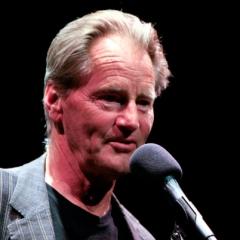
A good actor always sets you straight. If you've written a false moment and thought it was probably pretty great, the actor's gonna show you when he gets to that moment. They're the great test of the validity of the material.
Sam ShepardRead
23 quotes
A good actor always sets you straight. If you've written a false moment and thought it was probably pretty great, the actor's gonna show you when he gets to that moment. They're the great test of the validity of the material.
I stay away from heavy-handed stuff, the good guy and the bad guy. It just doesn't interest me; all it does is create more fences between people, I think.
I hate endings. Just detest them. Beginnings are definitely the most exciting, middles are perplexing and endings are a disaster. … The temptation towards resolution, towards wrapping up the package, seems to me a terrible trap. Why not be more honest with the moment? The most authentic endings are the ones which are already revolving towards another beginning. That’s genius.
There are places where writing is acting and acting is writing. I'm not so interested in the divisions. I'm interested in the way things cross over.
Democracy's a very fragile thing. You have to take care of democracy. As soon as you stop being responsible to it and allow it to turn into scare tactics, it's no longer democracy, is it? It's something else. It may be an inch away from totalitarianism.
On stage, you're not limited at all because you're free in language: language is the source of the imagination. You can travel farther in language than you can in any film.
There's no way to escape the fact that we've grown up in a violent culture, we just can't get away from it, it's part of our heritage. I think part of it is that we've always felt somewhat helpless in the face of this vast continent. Helplessness is answered in many ways, but one of them is violence.
If you start trying to figure out yourself from the image everyone has of you, you run into a dead end.
For me, playwriting is and has always been like making a chair. Your concerns are balance, form, timing, lights, space, music. If you don't have these essentials, you might as well be writing a theoretical essay, not a play.
When you write a play, you work out like a musician on a piece of music. You find all the rhythms and the melody and the harmonies and take them as they come.
When you consider all the writers who never even had a machine. Who would have given an eyeball for a good typewriter. Any typewriter. All the ones who wrote on a matchbook covers. Paper bags. Toilet paper. Who had their writing destroyed by their jailers. Who persisted beyond all odds.
Sometimes in someone's gestures you can notice how a parent is somehow inhabiting that person without there being any awareness of that. Sometimes you can look at your hand and see your father.
The wonderful thing about writing for theatre is you can go anywhere you want with the language. There are no limits. With film, they frown on language - it's always 'Too many words.'
It's very difficult to escape your background. You know, I don't think it's necessary to even try to escape it. More and more, I start to think that it's necessary to see exactly what it is that you inherited on both ends of the stick: your timidity, your courage, your self-deceit, and your honesty - and all the rest of it.
We're being sold a brand new idea of patriotism. It never occurred to me that patriotism had to be advertised. Patriotism is something you deeply felt. You didn't have to wear it on your lapel or show it in your window or on a bumper sticker. That kind of patriotism does not appeal to me at all.
I feel like the writers that I'm drawn to, the writers that I really cling to, are the writers who seem to be writing out of a desperate act. It's like their writing is part of a survival kit. Those are the writers that I just absolutely cherish and carry with me everywhere I go.
There is this aura that the three-act play is the important one: it's the one that you do to win the Pulitzer. Some part of you falls for that, and then after a while, you don't fall for that.
In real life we don't know what's going to happen next. So how can you be that way on a stage? Being alive to the possibility of not knowing exactly how everything is going to happen next - if you can find places to have that happen onstage, it can resonate with an experience of living.
I never considered myself a movie star, and I didn't want to become a movie star, because as soon as you do, you throw away that possibility of playing character. You really do. All of a sudden you're just an entity, you know?
I feel like I'm a natural-born playwright, but the prose thing has always mystified me. How to keep it going? How do people do it, for years and years?
Careers don't interest me. The only thing that interests me is continuing to be a poet on one level or another, whether acting or writing or directing.
Subscribe for the occasional hand-picked quote. No noise.