Physicians think they do a lot for a patient when they give his disease a name.
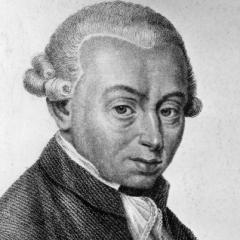
Immanuel KantRead
91 quotes
Physicians think they do a lot for a patient when they give his disease a name.
The inscrutable wisdom through which we exist is not less worthy of veneration in respect to what it denies us than in respect to what it has granted.
One cannot avoid a certain feeling of disgust, when one observes the actions of man displayed on the great stage of the world. Wisdom is manifested by individuals here and there; but the web of human history as a whole appears to be woven from folly and childish vanity, often, too, from puerile wickedness and love of destruction: with the result that at the end one is puzzled to know what idea to form of our species which prides itself so much on its advantages.
I shall never forget my mother, for it was she who planted and nurtured the first seeds of good within me. She opened my heart to the lasting impressions of nature; she awakened my understanding and extended my horizon and her percepts exerted an everlasting influence upon the course of my life.
. . . as to moral feeling, this supposed special sense, the appeal to it is indeed superficial when those who cannot think believe that feeling will help them out, even in what concerns general laws: and besides, feelings which naturally differ infinitely in degree cannot furnish a uniform standard of good and evil, nor has any one a right to form judgments for others by his own feelings. . . .
Two things fill the mind with ever new and increasing admiration and awe, the oftener and more steadily we reflect on them: the starry heavens above me and the moral law within me.
Our knowledge springs from two fundamental sources of the mind; the first is the capacity of receiving representations (receptivity for impressions), the second is the power of knowing an object through these representations (spontaneity [in the production] of concepts).
We can judge the heart of a man by his treatment of animals.
He who is cruel to animals becomes hard also in his dealings with men. We can judge the heart of a man by his treatment of animals.
Here I shall add that the concept of change, and with it the concept of motion, as change of place, is possible only through and in the representation of time. & Motion, for example, presupposes the perception of something movable. But space considered in itself contains nothing movable; consequently motion must be something which is found in space only through experience -in other words, is an empirical datum.
Physicians think they are doing something for you by labeling what you have as a disease
The schematicism by which our understanding deals with the phenomenal world ... is a skill so deeply hidden in the human soul that we shall hardly guess the secret trick that Nature here employs.
Upon the solution of this problem, or upon sufficient proof of the impossibility of synthetical knowledge a priori, depends the existence or downfall of metaphysics.
If justice perishes, human life on Earth has lost its meaning.
So act that anything you do may become universal law.
Human reason has the peculiar fate in one species of its cognitions that it is burdened with questions which it cannot dismiss, since they are given to it as problems by the nature of reason itself, but which it also cannot answer, since they transcend every capacity of human reason.
The universal and lasting establishment of peace constitutes not merely a part, but the whole final purpose and end of the science of right as viewed within the limits of reason.
Time is not an empirical concept. For neither co-existence nor succession would be perceived by us, if the representation of time did not exist as a foundation a priori.
Animals... are there merely as a means to an end. That end is man.
That Logic has advanced in this sure course, even from the earliest times, is apparent from the fact that, since Aristotle, it has been unable to advance a step, and thus to all appearance has reached its completion.
The possession of power inevitably spoils the free use of reason.
Subscribe for the occasional hand-picked quote. No noise.